Who made the photographs
Charleston photographers, 1860–1865
The men who carried cameras into Charleston, the firms they traded as, the addresses they worked from, and what can and cannot be proved about who made which photograph.
Before you read a credit
Three distinctions run through this whole section, and getting them wrong is how photographic history goes astray.
The photographer is not the firm. Osborn & Durbec was a business; James M. Osborn and F. E. Durbec were two men, and only one of them is on the record at Fort Sumter. Each has a page here, and they are not merged.
The publisher is not the photographer. An imprint on a card mount says who sold the picture. The Library of Congress holds a stereograph of Institute Hall published by Quinby & Co. at 261 King Street whose photography it attributes to Osborn & Durbec. Every work record here keeps the two in separate fields.
Where a man stood is not what he was. A photographer working in Confederate Charleston was not thereby a Confederate photographer, and one working beside Federal troops was not thereby a soldier. Sam Cooley was a sutler who awarded himself a federal title; Philip Haas actually enlisted; George S. Cook served in the home guard and held no appointment at all. Each record says which.
The photographers
- George N. Barnard23 December 1819 – 4 February 1902U.S. government employment or contract
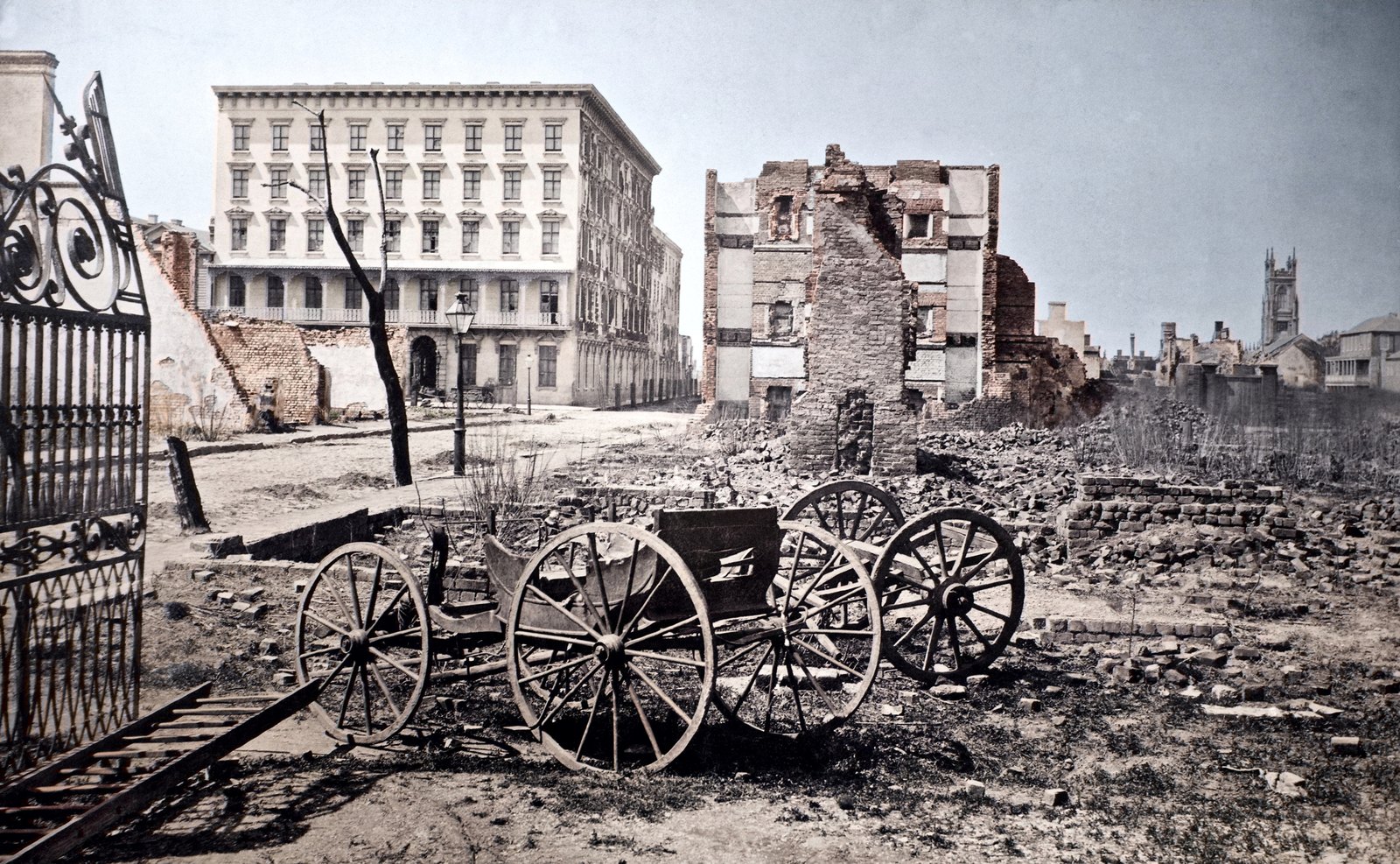
The photographer of Sherman’s campaigns, who spent several weeks in Charleston in the spring of 1865 and made the fullest photographic record of the ruined city — then came back after the war and worked there for years.
3 plates here · 4 works cataloged - Jesse H. Bollesdates not establishedCivilian, commercial
The Charleston gallery proprietor who employed Alma Pelot, sent him to Fort Sumter on 15 April 1861, and advertised the resulting views in the city’s newspapers. His gallery stood at No. 331 King Street; institutions credit him jointly with Pelot for the earliest photographs of the war at Charleston.
3 works cataloged - George LaGrange Cook1849 – 1919Civilian, unaffiliated
George S. Cook’s elder son, who learned photography from his father and ran the Charleston studio after the war. He belongs in this section as the postwar continuation of a wartime business, and is listed here so that his 1880s Charleston negatives are not mistaken for wartime ones.
- George Smith Cook23 February 1819 – 27 November 1902Civilian, unaffiliated
Charleston’s leading photographer of the Civil War era, and the man who carried a camera onto the parapet of Fort Sumter under fire in September 1863. He came to King Street in 1849 by way of New Orleans and Newark, built the city’s most successful gallery, and lost his stored wartime negatives in the burning of Columbia.
3 works cataloged - Samuel Abbot Cooley3 November 1821 – 15 May 1900U.S. government employment or contract
A Connecticut photographer who followed the 6th Connecticut Infantry south as a sutler, gave himself the title U.S. Photographer, Department of the South, and made a vast record of the Federal-held sea islands — and of Charleston Harbor once it fell.
1 plate here · 2 works cataloged - Jacob Frank Coonley1832 – 1915U.S. government employment or contract
A New York photographer, trained by George N. Barnard and long associated with the Anthony firm, who is credited by the Library of Congress with a stereo negative of the Fort Sumter flag-raising ceremony of 14 April 1865.
1 work cataloged - Frederick Eugene Durbec1836 – 1 October 1894Confederate service
The Charleston-born junior partner of Osborn & Durbec, who learned the trade with Tyler & Co. and Quinby before going into business with Osborn, and who left photography for the Beauregard Light Infantry Volunteers in 1862.
- Philip Haasborn about 1808Union service
A German-born lithographer who became a daguerreotypist in Washington, enlisted in his fifties, and photographed the Federal siege of Charleston from Morris Island in 1863 in partnership with Washington Peale.
- William E. James1835 – 1887Civilian, commercial
A Brooklyn stereo photographer who sailed to Charleston on the steamer Oceanus for the Fort Sumter flag-raising of 14 April 1865 and published the result under his own Fulton Street imprint.
1 work cataloged - James M. Osborn1811 – 1868Civilian, commercial
The senior partner of Osborn & Durbec, and the Charleston photographer who went out to Fort Sumter after its surrender and made twenty-six views of it. He was on the parapet with George S. Cook on 8 September 1863 when the monitors came in.
- Washington Pealedates not establishedStatus not established
The junior name on one of the most important photographic partnerships of the Charleston campaign, and the one about whom least is known. Davis and Melton place him in Philadelphia and then Washington before the war, a painter like his father.
- Alma A. Pelotdates not establishedCivilian, commercial
The photographer who reached Fort Sumter first. Working for Jesse Bolles, Pelot went out to the fort on 15 April 1861, the day after the garrison marched out, and made the earliest surviving photographs of the place where the war started — including the Confederate flag flying over it.
5 works cataloged - Charles J. Quinby29 February 1832 – 13 March 1920Civilian, commercial
The proprietor of the King Street gallery where Charleston went to be photographed in the spring of secession. Mary Chesnut sat for him and hated the result; Edmund Ruffin sat for him and could not keep up with the demand for the prints.
- Selmar Rush Seibert1826 – 1909U.S. government employment or contract
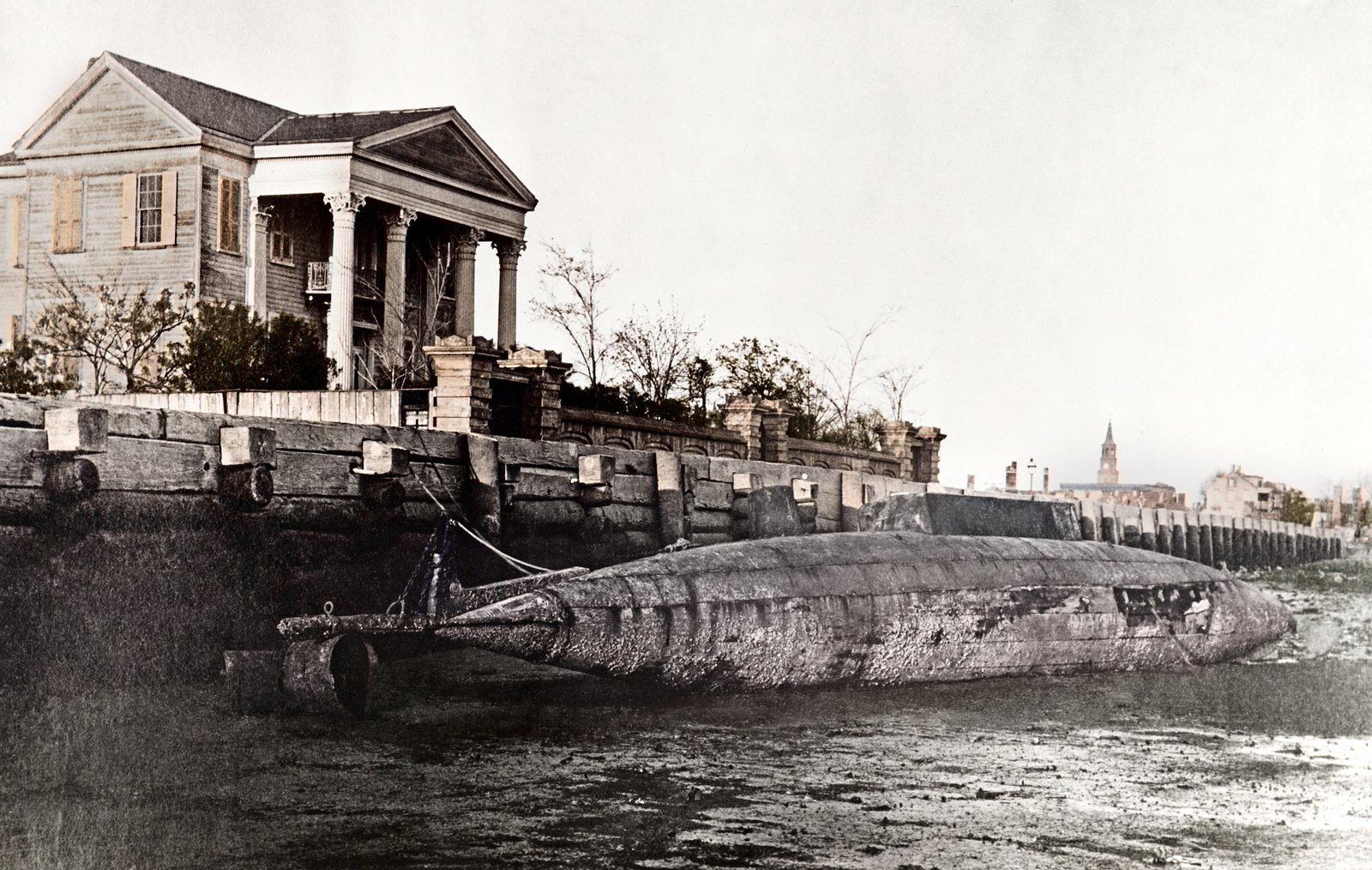
The photographer credited with the 1865 views of a David-type torpedo boat aground at Charleston and of captured Confederate ordnance at the arsenal — pictures that survive in the National Archives and are among the few close records of Confederate naval technology.
1 plate here
Firms, galleries and publishers
- E. & H. T. Anthony & Co.New York
The New York firm that published and distributed a great deal of what America saw of the war, including Charleston views made by other men. An Anthony imprint on a mount identifies the publisher; it does not identify the photographer.
- George S. Cook’s galleryCharleston, South Carolina · 1849–1891
The King Street gallery George Smith Cook ran from 1849 until the family business closed it in 1891 — a portrait studio and a photographic supply business, and the base from which Cook photographed the war in Charleston Harbor.
- Haas & PealeMorris Island and Hilton Head, South Carolina · 1862–1863
The wartime partnership of Philip Haas and Washington Peale, who photographed General Quincy A. Gillmore’s operations against Charleston in 1863 from studios on Morris Island and at Hilton Head. Their glass negatives came to the Library of Congress in 1966.
- J. H. Bolles’s photographic galleryCharleston, South Carolina
The Charleston gallery of Jesse Henry Bolles, for whom Alma A. Pelot was working when he made the first photographs of Fort Sumter after its surrender, on 15 April 1861. It stood at No. 331 King Street.
- Mathew B. Brady’s studiosNew York and Washington
Brady employed two of the photographers who later worked at Charleston, and his name on a wartime photograph is as likely to mean his firm published it as that he stood behind the camera.
- Osborn & Durbec’s Southern Stereoscopic & Photographic DepotCharleston, South Carolina · 1858–1862
The Charleston partnership of James M. Osborn and Frederick Eugene Durbec, trading from No. 223 King Street as a photographic depot — a gallery and a supply house in one. It made the stereoscopic record of Charleston, its harbor forts and the plantations around it that survives in the Library of Congress today.
- Osborn’s GalleryCharleston, South Carolina · 1862–1868
James M. Osborn’s own gallery, opened at King and Liberty streets after the Osborn & Durbec partnership ended in February 1862, and worked through the rest of the war. The Metropolitan Museum of Art records the gallery as the publisher of cartes de visite of Fort Sumter taken in April 1861.
- Quinby & Co.Charleston, South Carolina · 1857–1871
Charles J. Quinby’s Charleston gallery, successor in February 1857 to Tyler & Co. at No. 233 King Street and by 1861 at No. 261 King Street. This is where Charleston went to be photographed in the spring of secession, and its backmark is the reason a great many surviving Charleston portraits can still be attributed.
- Sam A. Cooley, U.S. Photographer, Department of the SouthBeaufort, Hilton Head and Folly Island, South Carolina; Jacksonville, Florida · 1862–1865
The photographic business Samuel A. Cooley ran behind the Union lines on the South Carolina coast, advertised under a title he awarded himself. He brought three assistants down from New York and worked from at least four places.
- Tyler & Co.Charleston, South Carolina · –1857
The Charleston gallery at No. 233 King Street to which Quinby & Co. succeeded in February 1857, and where F. E. Durbec first worked in photography.
Where they worked
Charleston renumbered its streets between 1882 and 1886, and no conversion table survives. A wartime street number therefore cannot be turned into a modern address, and nothing in this section pretends otherwise: every studio is mapped at the level its evidence supports, and the level is printed beside it.
Open the mapThe worksThe chronology
In this collection, by a named hand