An account
How a photograph was made at Fort Sumter
Wet collodion had to be coated, exposed and developed before it dried. Everything about field photography in Charleston follows from that one fact.
A wet-plate photographer could not simply carry a camera. The process required a sheet of glass to be flowed with collodion, sensitized in a bath of silver nitrate, exposed while still wet, and developed immediately — a working window of perhaps ten or fifteen minutes from coating to fixing.
So the darkroom went where the camera went. A wagon, a tent, or a converted room within reach of the tripod; bottles, baths, a supply of clean water; and glass, which is heavy and breaks.
What that meant at Charleston
It meant that photographing Fort Sumter was an expedition. Alma Pelot had to be landed at the fort with his outfit on 15 April 1861 and be finished before his plates dried. Osborn made twenty-six views, which means twenty-six coatings, exposures and developments in the same conditions.
It meant that Haas & Peale kept studios on Morris Island and at Hilton Head rather than traveling light, and that Sam Cooley ran four locations and three assistants.
And it meant that when the wind was wrong or the fort was under fire, there were no photographs at all. The gaps in the record are not always gaps in interest.
The one picture that shows it
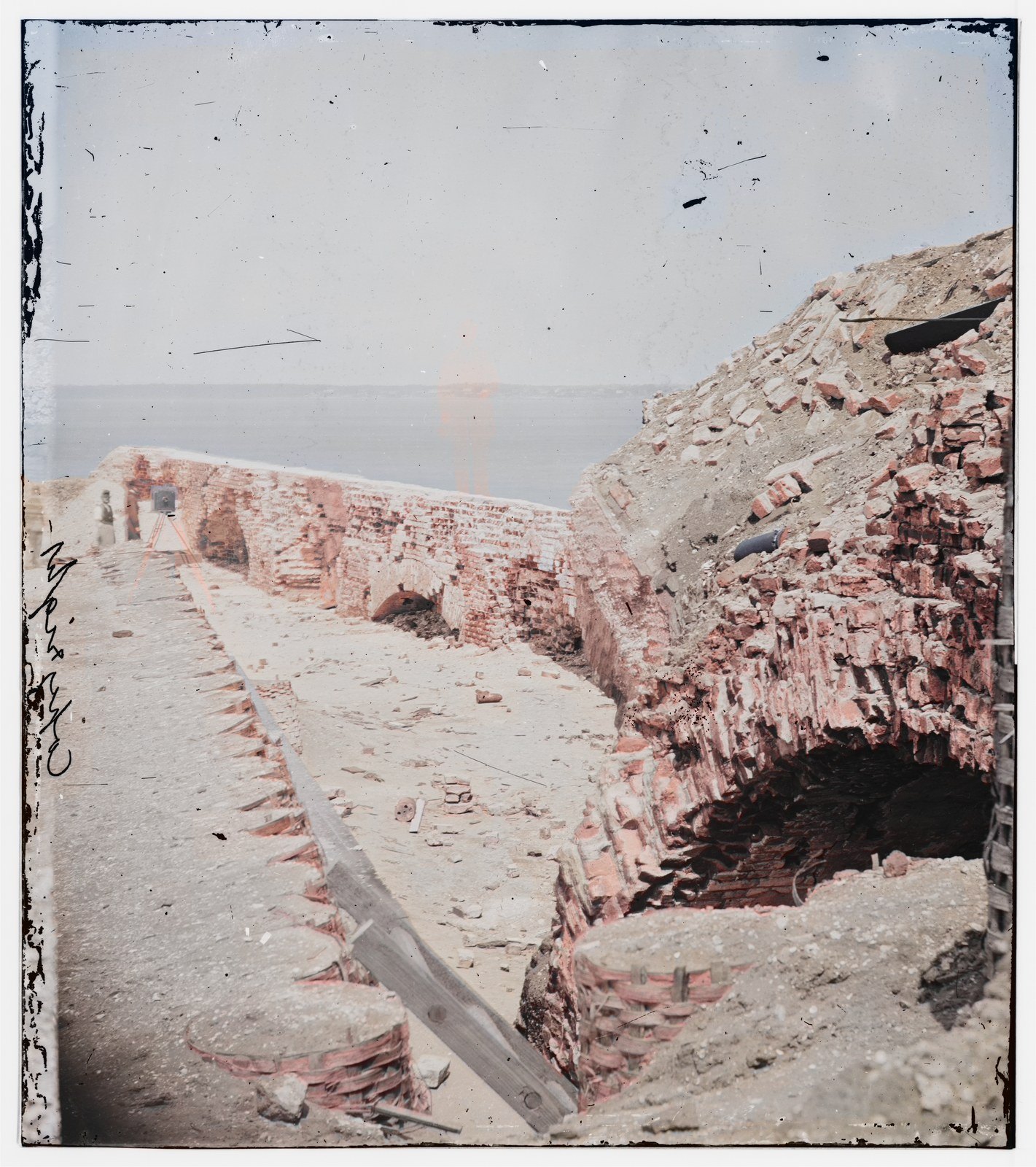
In April 1865 a photographer on the parapet of Fort Sumter photographed another photographer at work: Sam Cooley standing beside his camera, wagon behind him, on the broken masonry. Davis and Melton credit George N. Barnard with the exposure; the Library of Congress record names Cooley in the title and leaves the creator blank.
Whoever made it, it is the best evidence in this section of what the work actually looked like.
The photographs
The works
- Sam Cooley and his camera on the parapet of Fort Sumter1865 April. · George N. BarnardAttributedLibrary of Congress · LC-B811- 3053 [P&P]; LOT 4166-C (corresponding photographic print)
- Charleston, South Carolina. Beacon on parapet of Fort Sumter1865. · Samuel Abbot CooleyVerifiedLibrary of Congress · LC-B811- 3055 [P&P]
The photographers
Samuel Abbot Cooley George N. Barnard Alma A. Pelot Philip Haas
Statement by statement
- VerifiedWet collodion plates had to be coated, exposed and developed before drying, which required a darkroom in the field.Davis & Melton 2020
- VerifiedCooley worked with three assistants brought from New York and studios at Beaufort, Hilton Head, Folly Island and Jacksonville.Davis & Melton 2020
- AttributedBarnard exposed the negative showing Cooley on the parapet.Davis & Melton 2020
Sources
- Stephen Davis and Jack W. Melton Jr., 100 Significant Civil War Photographs: Charleston in the War (Charleston: Historical Publications LLC, 2020).
- Prints and Photographs Division, Library of Congress, Washington, D.C. https://www.loc.gov/pictures/
Last reviewed 2026-08-30 (Claude, for Historical Publications LLC).