Union field photographers
Samuel Abbot Cooley
A Connecticut photographer who followed the 6th Connecticut Infantry south as a sutler, gave himself the title U.S. Photographer, Department of the South, and made a vast record of the Federal-held sea islands — and of Charleston Harbor once it fell.
Like George S. Cook and George N. Barnard, Cooley was born in Hartford, Connecticut, and was a photographer there before the war.
He did not enlist — possibly for reasons of health. He attached himself instead to the 6th Connecticut Infantry as a sutler, the licensed civilian merchant who followed a regiment selling what the army did not issue, and in that capacity he came down to the South Carolina coast. He was not merely a shopkeeper in uniformed company: after a small action near Pocotaligo on 22 October 1863, Brigadier General John M. Brannan commended “Mr. Cooley, sutler of the Sixth Connecticut Volunteers” for helping to bring wounded men off the field.
Then he did what Alexander Gardner had done with the Army of the Potomac: he gave himself a title. Cooley advertised as U.S. Photographer, Department of the South — the Union-held coastal territory run from Hilton Head — and sometimes as Photographer Tenth Army Corps. In that semi-official position he photographed army installations along with a great many scenes of Beaufort and the people living there.
It was a business as well as a calling. He brought three assistants down from New York and worked for customers out of a studio at Beaufort; the back of one of his cartes de visite lists studios at Hilton Head, Folly Island and Jacksonville, Florida. Harvey Teal estimates that Cooley and his assistants produced more than two thousand images of Beaufort, Hilton Head and the sea islands.
After the war he returned to Hartford, where he died on 15 May 1900.
The Charleston connection
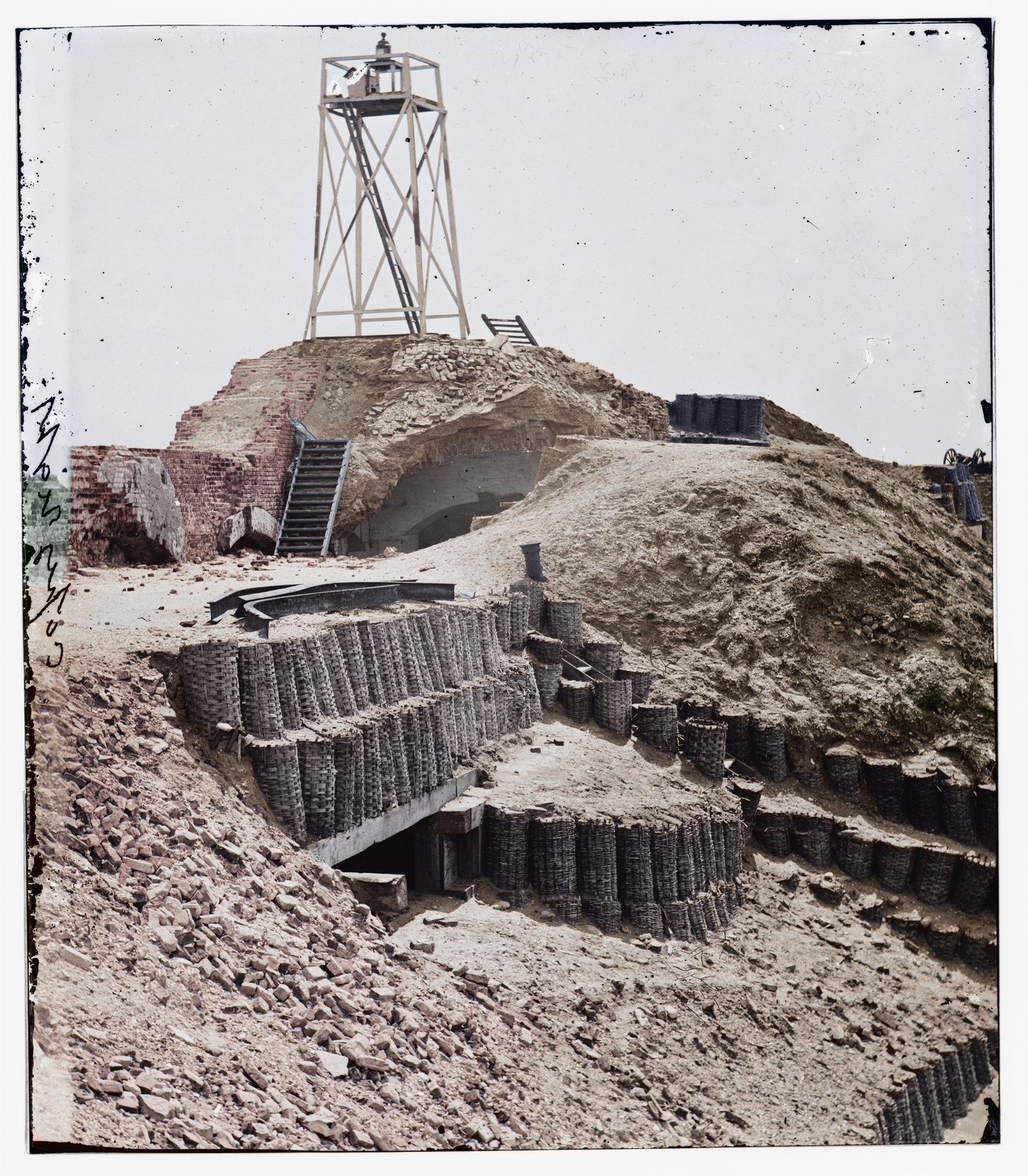
Cooley came to Charleston with the occupation. The Library of Congress credits him as photographer of a Fort Sumter parapet negative of 1865 and attributes to him a stereograph of the ordnance yard on Morris Island, taken in April of that year, on the evidence of the corresponding negative number.
He is also, uniquely among the men in this section, visible at work: a negative of April 1865 shows him standing beside his camera on the parapet of Fort Sumter, his wagon behind him.
War service and standing
Civilian sutler to the 6th Connecticut Infantry. Commended by Brigadier General John M. Brannan for recovering wounded after the action near Pocotaligo, 22 October 1863. No enlistment, no commission, and no formal appointment as army photographer.
Process and equipment
The wagon in his Fort Sumter portrait is the reason any of it was possible. Wet collodion had to be coated, exposed and developed before the plate dried, so a photographer working in the field carried his darkroom with him or made no pictures at all.
Working with three assistants and four locations, Cooley ran a production operation rather than a one-man practice, which is worth remembering when a picture is credited to him: the credit is to the business as often as to the hand.
Attribution
Cooley’s name is attached to more pictures than Cooley took. The three assistants and four studios mean that “Cooley” on a mount identifies the business; and the Library of Congress, attributing his Morris Island ordnance-yard stereograph, says so in the record: attributed to Samuel A. Cooley, based on the negative number.
Career
- 1821Born at Hartford, Connecticut, 3 November. Davis & Melton 2020
- 1862–1865Sutler to the 6th Connecticut Infantry on the South Carolina coast; photographs the Department of the South. Davis & Melton 2020
- 22 October 1863Commended by Brigadier General John M. Brannan after the action near Pocotaligo. Davis & Melton 2020
- April 1865At Fort Sumter; photographed on the parapet with his camera. Library of Congress Davis & Melton 2020
- 1900Dies at Hartford, 15 May. Davis & Melton 2020
Do not confuse with
- Jacob Frank Coonley — Cooley and Coonley are different men. Cooley was a sutler-photographer in the Department of the South; Coonley was a New York photographer who worked for Brady and Anthony and is credited with a Fort Sumter flag-raising view. The names are one letter apart and are confused constantly.
- George Smith Cook — Confederate Charleston’s leading photographer, working on the other side of the same harbor.
Photographs in this collection
Representative works
- Charleston, South Carolina. Beacon on parapet of Fort Sumter1865. · Samuel Abbot CooleyVerifiedLibrary of Congress · LC-B811- 3055 [P&P]
- Ordnance ya[rd], Morris Island, near Charleston, S.C.[1865 April] · Samuel Abbot CooleyAttributedLibrary of Congress · LOT 4172, no. 201 [P&P]
Working locations
- Cooley’s Beaufort galleryBeaufort · 1862–1865Located to a district or town
- Cooley’s Hilton Head studioHilton HeadLocated to an island
- Cooley’s Folly Island studioFolly IslandLocated to an island
- Cooley’s Jacksonville studioJacksonville, Fla.Located to a district or town
- The parapet of Fort SumterFort Sumter · 1861–1865Located to the building itself
Where the work is
- Library of Congress Civil War photographs, 1861–1865: negatives and stereographs credited or attributed to Cooley.
See also
George N. Barnard Jacob Frank Coonley George Smith Cook
Statement by statement
Every material claim on this page, with its standing and its source. A statement the record does not support is shown as unavailable rather than filled in.
- AttributedBorn at Hartford, Connecticut, 3 November 1821; died there 15 May 1900.Davis & Melton 2020
- VerifiedServed as sutler to the 6th Connecticut Infantry and did not enlist.Davis & Melton 2020
- VerifiedCommended by Brigadier General John M. Brannan after Pocotaligo, 22 October 1863.Davis & Melton 2020
- VerifiedAdvertised as U.S. Photographer, Department of the South, and as Photographer Tenth Army Corps.Davis & Melton 2020
- VerifiedCredited by the Library of Congress as photographer of the Fort Sumter beacon negative LC-B811-3055.Library of Congress
- AttributedProduced, with his assistants, more than two thousand images of Beaufort, Hilton Head and the sea islands.Teal, Partners with the Sun Davis & Melton 2020
Sources
- Stephen Davis and Jack W. Melton Jr., 100 Significant Civil War Photographs: Charleston in the War (Charleston: Historical Publications LLC, 2020).
- Prints and Photographs Division, Library of Congress, Washington, D.C. https://www.loc.gov/pictures/
- Harvey S. Teal, Partners with the Sun: South Carolina Photographers, 1840–1940 (Columbia: University of South Carolina Press, 2001).