Union field photographers, Visiting photographers
George N. Barnard
The photographer of Sherman’s campaigns, who spent several weeks in Charleston in the spring of 1865 and made the fullest photographic record of the ruined city — then came back after the war and worked there for years.
Barnard was born at Coventry, Connecticut, on 23 December 1819 and began working in photography in the 1840s. For the first two years of the war he worked under Mathew Brady; in late 1863 the Union army employed him directly, and he became official photographer to the Military Division of the Mississippi.
He published sixty of his views of the Atlanta campaign, Nashville, Savannah, Columbia and Charleston in Photographic Views of Sherman’s Campaign in 1866 — one of the great photographic books of the century.
Between 1868 and 1871 he was back in Charleston, in partnership with the Quinby & Co. studio at 261 King Street. After a spell in Chicago he returned again in 1873 for seven more years of work before moving to Rochester, New York. He died at Syracuse on 4 February 1902.
The Charleston connection
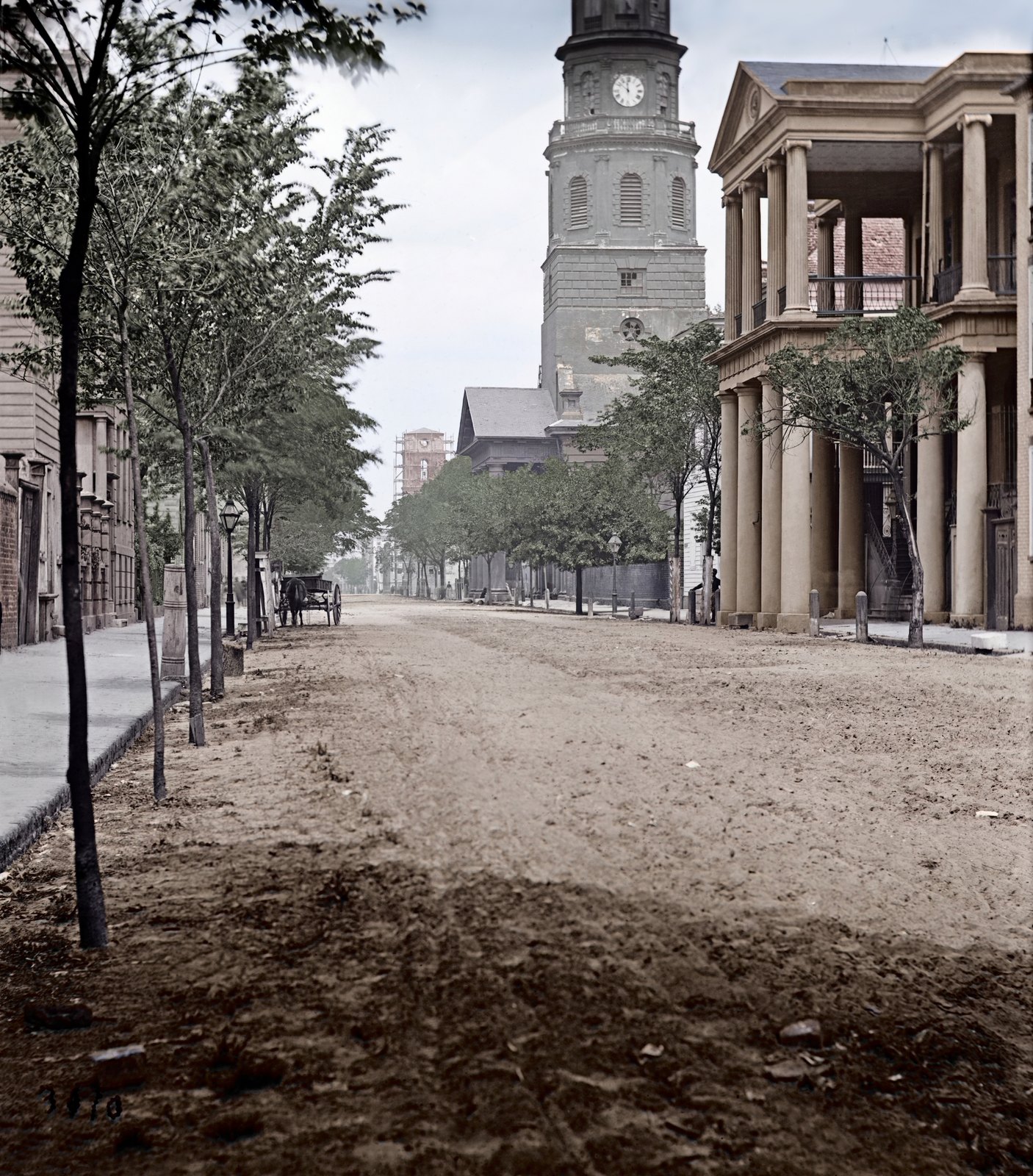
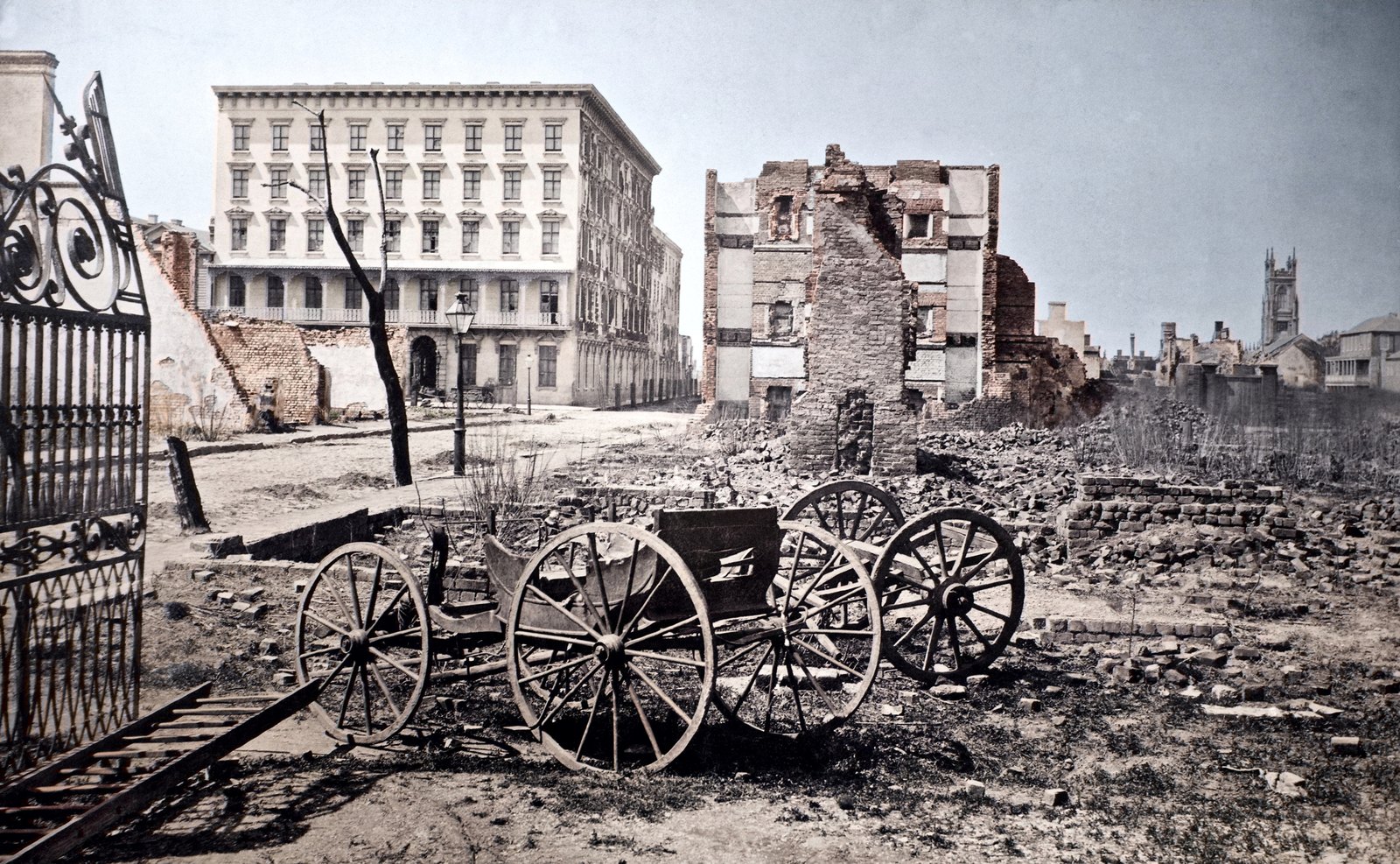
Barnard’s Charleston pictures date from the spring of 1865, when he spent several weeks in the city — a city that had been shelled for five hundred and eighty-seven days, burned in 1861, and evacuated in February. What he made there is the fullest photographic account of the place in ruins.
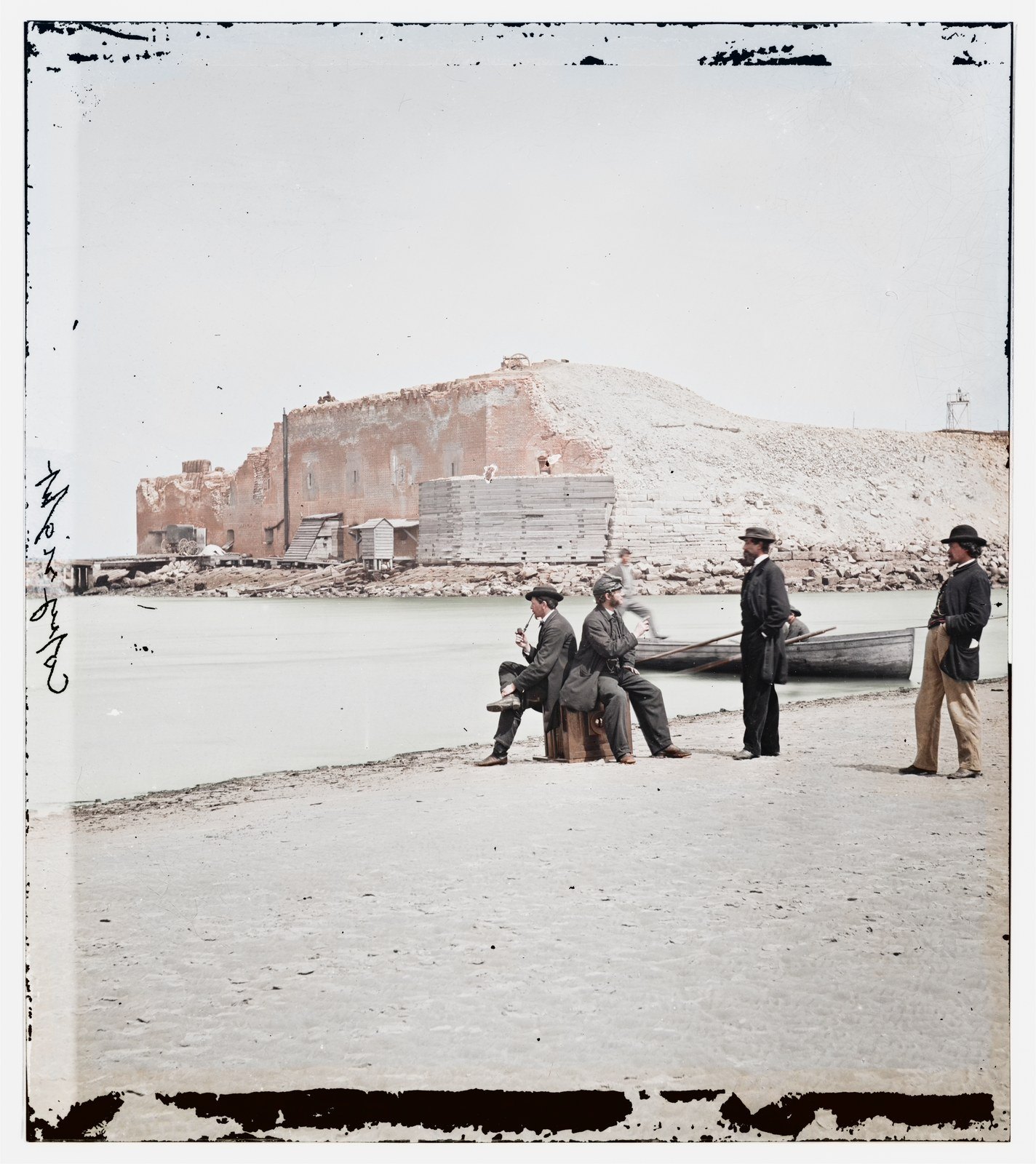
His album includes three views of Fort Sumter after nearly two years of Federal bombardment. He photographed the ground destroyed in the great fire of 11 December 1861 — the Pinckney mansion on East Bay Street, the Circular Congregational Church in scaffolding and under reconstruction — and the wreck of the Northeastern Depot, blown up during the Confederate evacuation of 17–18 February 1865.
He also photographed Sam Cooley at work on the parapet of Fort Sumter, which is how we know what a field photographer and his wagon looked like in April 1865.
War service and standing
Civilian employee of the United States army from late 1863, after two years with Brady. Official photographer to the Military Division of the Mississippi.
Process and equipment
Wet-plate glass negatives, including stereo pairs cut from single plates — the Library of Congress’s Charleston negatives of April 1865 are two-plate stereo glass, wet collodion, and its catalog notes which half is which.
Attribution
Barnard is the best-attributed photographer in this section — the Library of Congress carries his name and dates in its authority record — and even so, most of the April 1865 Charleston negatives in LOT 4166-C have no creator in the catalog at all. Where the Library credits him, this site credits him. Where it does not, the attribution is recorded as the book’s and marked as such.
Career
- 1819Born at Coventry, Connecticut, 23 December. Davis & Melton 2020 Library of Congress
- 1861–1863Works under Mathew Brady. Davis & Melton 2020
- late 1863Employed by the Union army as a photographer. Davis & Melton 2020
- March–April 1865Several weeks in Charleston; photographs the ruined city and Fort Sumter. Davis & Melton 2020 Library of Congress
- 1866Publishes Photographic Views of Sherman’s Campaign. Davis & Melton 2020 Barnard, Photographic Views
- 1868–1871In partnership with Quinby & Co. at 261 King Street, Charleston. Davis & Melton 2020
- 1873–1880Working in Charleston again. Davis & Melton 2020
- 1902Dies at Syracuse, New York, 4 February. Davis & Melton 2020 Library of Congress
Photographs in this collection
Representative works
- Charleston, South Carolina. View of Charleston from the roof of the Orphan Asylum1865 [April] · George N. BarnardVerifiedLibrary of Congress · LC-B811- 3420 [P&P]; LOT 4163 (corresponding photographic print)
- [Charleston, S.C. Fort Sumter, from the sand-bar]1865 April. · George N. BarnardVerifiedLibrary of Congress · LC-B811- 3047 [P&P]; LOT 4166-C (corresponding photographic print)
- Charleston, South Carolina. Ruins of Secession Hall1865 [April] · George N. BarnardVerifiedLibrary of Congress · LC-B811- 3447 [P&P]; LOT 4163 (corresponding photographic print)
- Sam Cooley and his camera on the parapet of Fort Sumter1865 April. · George N. BarnardAttributedLibrary of Congress · LC-B811- 3053 [P&P]; LOT 4166-C (corresponding photographic print)
Working locations
- Quinby Photograph and Fine Art Gallery261 King Street · 1861–1871Located to the block or named intersection
- The parapet of Fort SumterFort Sumter · 1861–1865Located to the building itself
Where the work is
- Library of Congress Civil War glass negatives; LOT 4163 and LOT 4166-C hold the Charleston prints.
See also
Samuel Abbot Cooley Jacob Frank Coonley Charles J. Quinby
Statement by statement
Every material claim on this page, with its standing and its source. A statement the record does not support is shown as unavailable rather than filled in.
- VerifiedBorn 23 December 1819 at Coventry, Connecticut; died 4 February 1902 at Syracuse, New York.Davis & Melton 2020 Library of Congress
- VerifiedWorked under Mathew Brady for the first two years of the war, then for the army from late 1863.Davis & Melton 2020
- VerifiedPhotographed Charleston over several weeks in the spring of 1865.Davis & Melton 2020 Library of Congress
- VerifiedCredited by the Library of Congress with the negative LC-B811-3047, Fort Sumter from the sand-bar.Library of Congress
- VerifiedPartnered with Quinby & Co. at 261 King Street, 1868–1871, and worked in Charleston again from 1873.Davis & Melton 2020
Sources
- Stephen Davis and Jack W. Melton Jr., 100 Significant Civil War Photographs: Charleston in the War (Charleston: Historical Publications LLC, 2020).
- Prints and Photographs Division, Library of Congress, Washington, D.C. https://www.loc.gov/pictures/
- George N. Barnard, Photographic Views of Sherman’s Campaign (New York, 1866).