Politician, Official, Planter
John C. Calhoun
1782 – 1850
The architect of nullification, dead a decade before secession, whose grave was dug up and hidden during the war to keep Federal soldiers from it.
Calhoun died in 1850 and is included for his grave, which is a wartime subject: it was moved during the war and photographed after it. The exact dates of the wartime removal and of the 1884 return have not been established here.
Charleston
Calhoun died ten years before the state he had prepared left the Union, and his connection to the war at Charleston is his grave. He was buried in the western section of St. Philip's churchyard — the part the congregation had set aside in the 1760s as a burial ground for strangers, meaning those who were not Charlestonians but died in the city. The most famous South Carolinian of his century was laid in the strangers' ground.
He did not stay. As Federal capture of the city began to look certain, his remains were dug up again and reburied in an unmarked grave in the eastern churchyard, on the reasoning that Union soldiers who found the marked grave of the author of nullification might not leave it alone. The precaution worked, in the sense that nothing was disturbed. In 1884 what was left of him was returned to the original plot. Three burials, two exhumations, and a war in between.
The grave was a destination even in 1865: Federal officers came to look at it, and photographers came to record them looking. What the camera found was a plain enclosure — the monument that stands over the grave today came later.
Life
Born in the Abbeville District of the South Carolina upcountry, with a degree from Yale and law read at Litchfield in Connecticut — a Northern education that shaped an intensely Southern career. He entered Congress in 1811 as one of the War Hawks, and in those years he was a nationalist: for a national bank, for internal improvements, for a standing army.
He was Secretary of War under Monroe, then Vice President under John Quincy Adams and again under Andrew Jackson — one of only two men to serve two presidents in that office. He broke with Jackson and in December 1832 resigned the vice presidency to take a Senate seat where he could fight, the first vice president to quit the job. He was later Secretary of State under Tyler.
The turn came with the tariff. His anonymous South Carolina Exposition and Protest of 1828 argued that a state could declare a federal law null within its borders, and the doctrine brought the state to the edge of armed confrontation with Jackson in 1832-33. As the argument shifted from tariffs to slavery, he abandoned the older Southern habit of calling the institution a necessary evil and told the Senate in 1837 that it was instead a positive good. It is the sentence that fixed his reputation, and he meant it.
Service
Not yet documented.
Places
Commemorated at St. Philip’s Church
date not established · confirmed
Burial
ReinterredSt. Philip’s Church
Buried 1850 · high confidence
He died in Washington and was interred there for a time. His remains were then exhumed and carried to Charleston for a large funeral procession, and buried in the western section of St. Philip's churchyard — the part the congregation had set aside as a burial ground for strangers, meaning those who were not Charlestonians but died in the city. The most famous South Carolinian of his century was laid in the strangers' ground.
ReinterredSt. Philip’s Church
Buried date not established · high confidence
As Federal capture of the city began to look certain, Calhoun's remains were dug up and reburied in an unmarked grave in the eastern churchyard, on the reasoning that Union soldiers who found the marked grave of the author of nullification might not leave it alone. The precaution worked, in the sense that nothing was disturbed.
ReinterredSt. Philip’s Church present grave
Buried 1884 · high confidence
In 1884 what was left of him was returned to the original plot, where he remains. Three burials, two exhumations, and a war in between. The monument that stands over the grave today came later than the photographs in this collection, which show a plain enclosure.
A burial date is not a death date, and a cenotaph is not a grave. Where a coordinate locates the cemetery and not the plot, the entry says so.
Photographs
What is established, and on whose authority
- verifiedBorn 18 March 1782 in the Abbeville District; died 31 March 1850 in Washington.Davis & Melton 2020
- verifiedSecretary of War under Monroe, Vice President under John Quincy Adams and Andrew Jackson, and Secretary of State under Tyler.Davis & Melton 2020
- verifiedResigned the vice presidency in December 1832 to take a Senate seat — the first vice president to quit the office.Davis & Melton 2020
- verifiedWrote the anonymous South Carolina Exposition and Protest of 1828, arguing that a state could nullify a federal law.Davis & Melton 2020
- verifiedTold the Senate in 1837 that slavery was a positive good rather than a necessary evil.Davis & Melton 2020
- verifiedHis remains were moved from the western churchyard of St. Philip's to an unmarked grave in the eastern churchyard as Federal capture of Charleston began to look certain, and returned to the original plot in 1884.Davis & Melton 2020
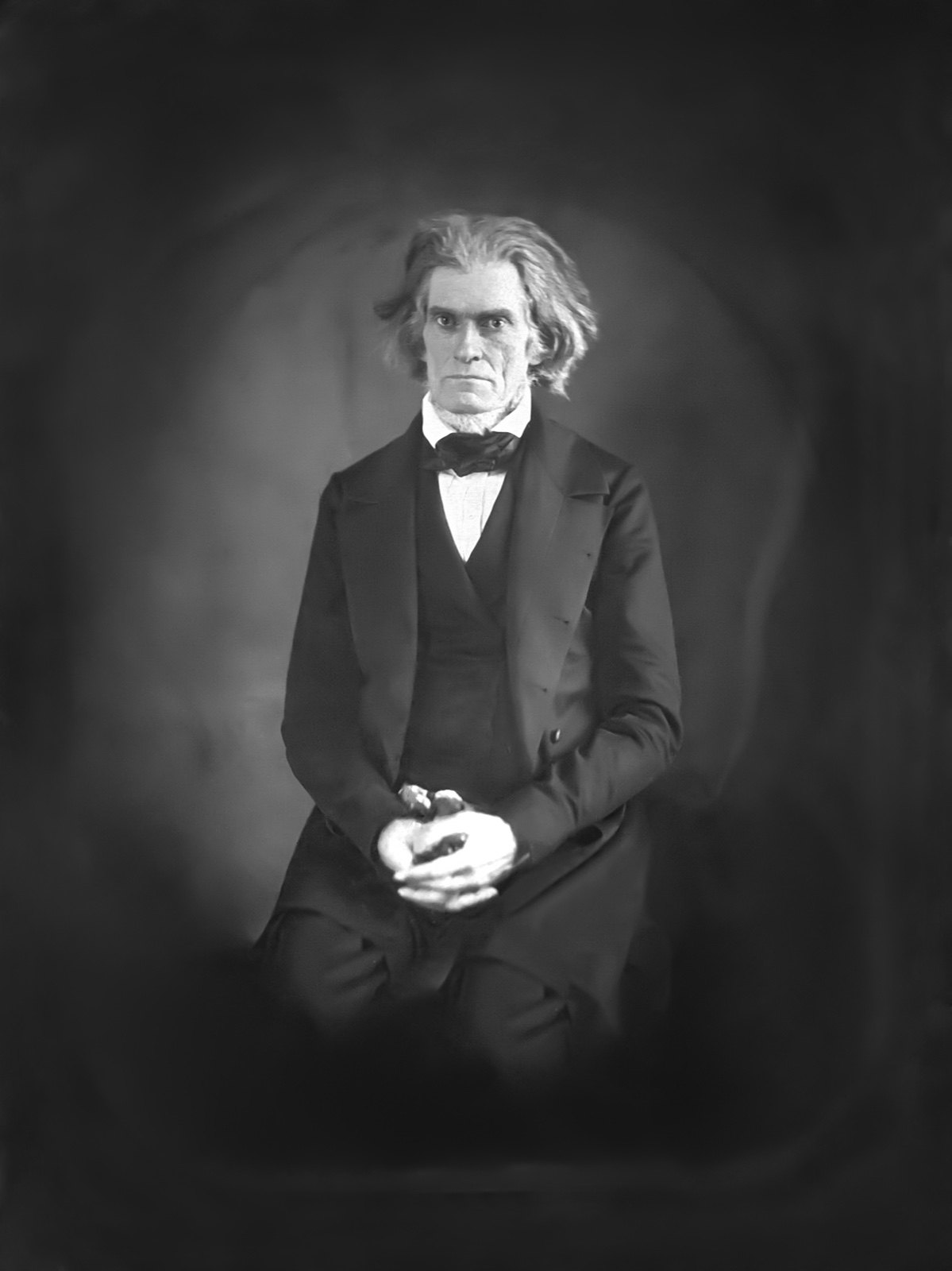
- verifiedThe portrait plate catalogued here as “John C. Calhoun” shows this person.Library of Congress
Identity: verified. Last checked 31 August 2026.
Corrections to this record are welcome through the publisher.