Library of Congress
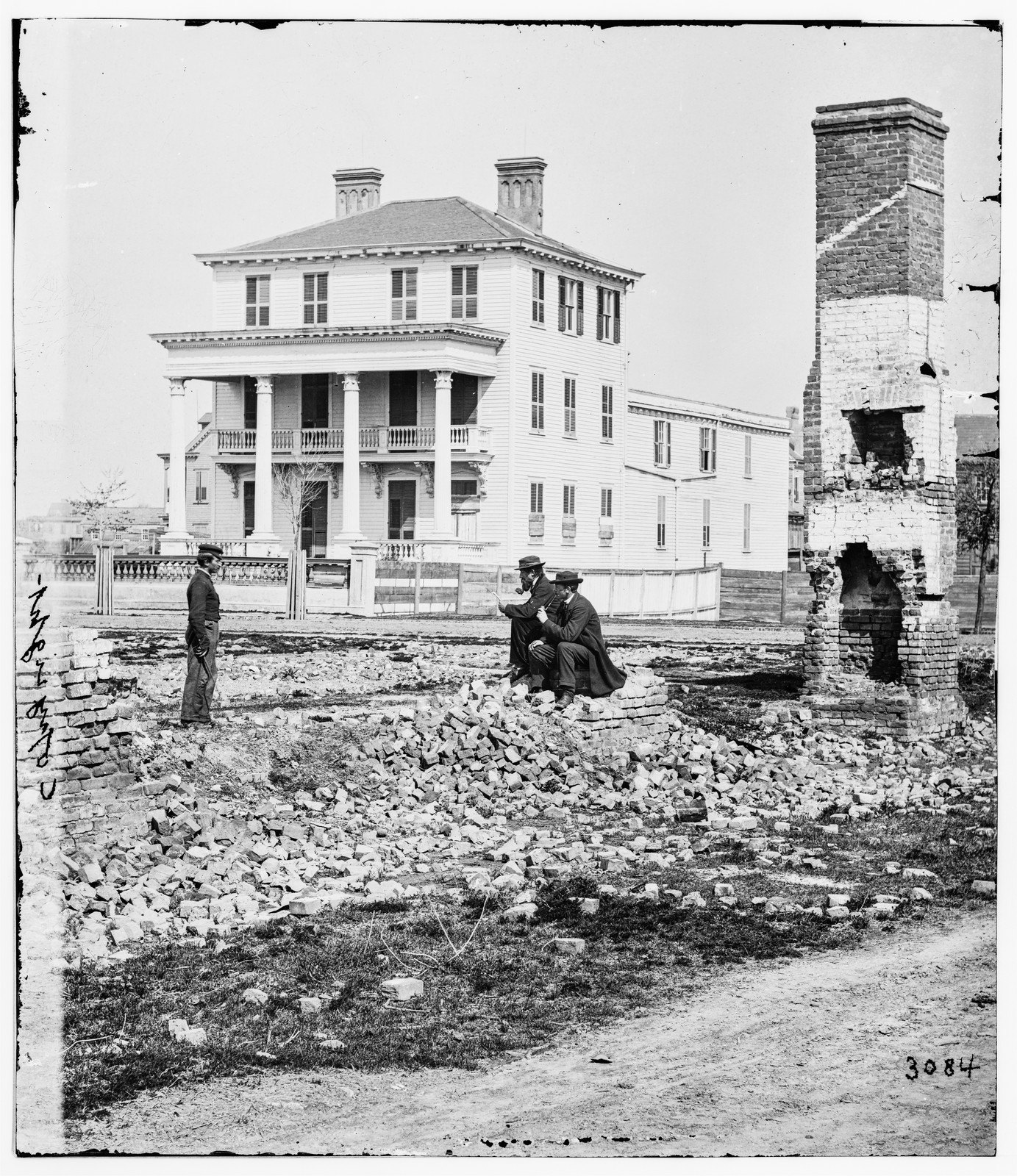
The O'Connor House, Another View
Original scanLibrary of Congress
A second view of Patrick O'Connor's house at Broad and Rutledge — white-columned, curiously whole — with two men sitting on the rubble of its neighbor and a scorched chimney standing alone at the right of the frame.
In June 1864 the Confederate authorities turned this house into a prison for captured Union officers, and the address was the point: fifty of them — five generals and forty-five field officers — were ordered confined in the part of the city under fire from the Federal guns on Morris Island, as retaliation, openly stated. The reasoning was that Northern gunners would not shell a district holding their own officers. They were wrong; the shelling continued.
The Federal answer was in kind and worse: six hundred Confederate prisoners brought down to a stockade on Morris Island, directly under the Confederate harbor guns — the men afterward known as the Immortal Six Hundred. Each side had made hostages of prisoners to protect a position, and neither side stopped firing.
Sergeant Augustine Smythe of the Signal Corps, whose letters run through this collection, inspected the arrangements with a prisoner's-keeper's grievance — a splendid house, a yard to walk in, gas fixtures put up at the Confederacy's expense — and reported the captives perfectly contented. The companion view is published with his letter alongside.