Charleston Scenes · Book p. 69
A Slab of Tabby
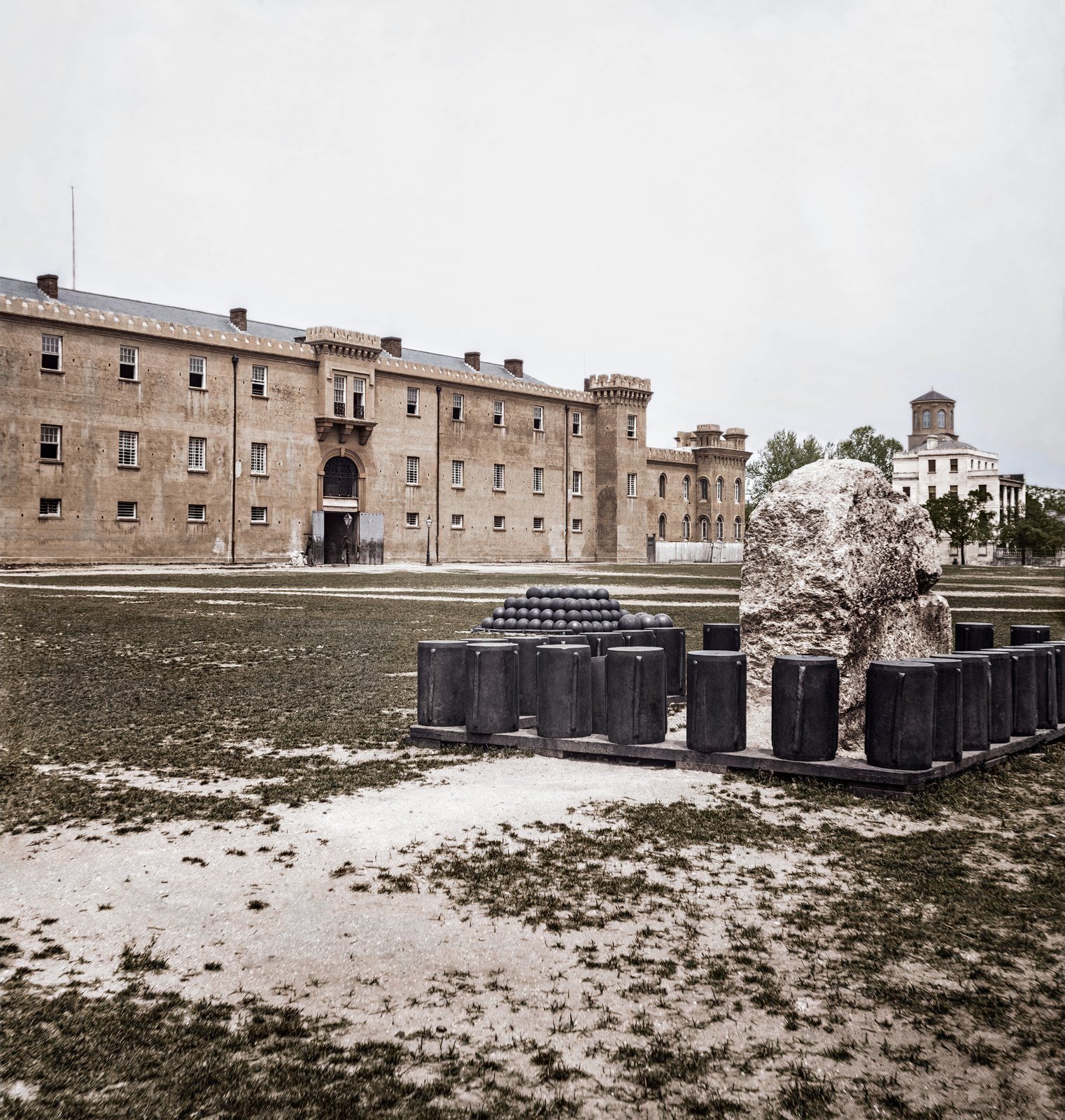
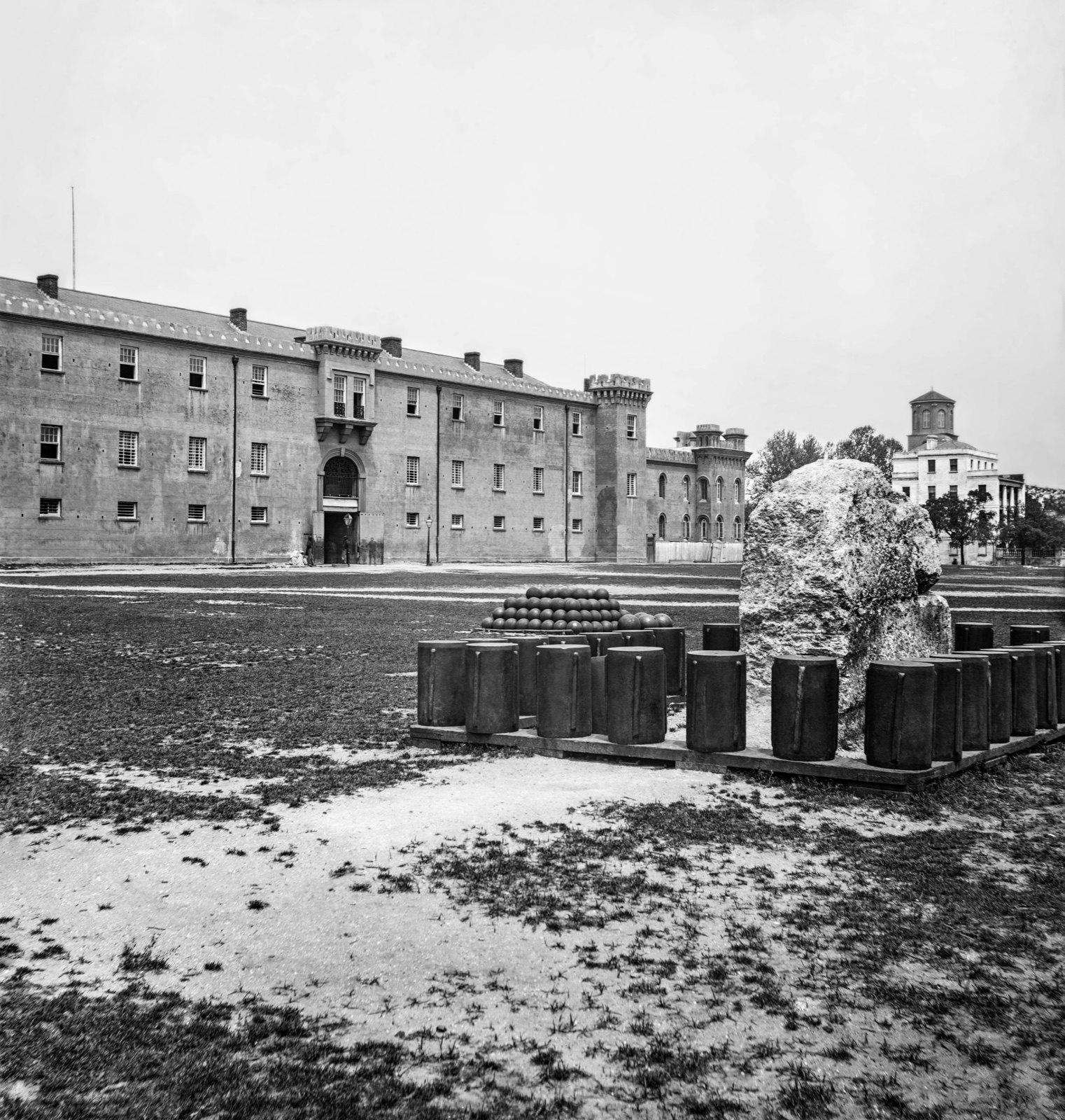
A block of colonial tabby ringed by Blakely bolts, in front of the Citadel.
Drag to compareLibrary of Congress
In front of the Citadel — the South Carolina Military Academy — in Marion Square, a rectangle of 12.75-inch Blakely shot has been laid out around a lump of masonry from Charleston's colonial defenses.
The lump is tabby, and it is worth knowing what that is. Tabby is coastal concrete: lime burned from oyster shells, mixed with sand, water and more whole shells, poured in lifts between boards. The Lowcountry had no good building stone and an inexhaustible supply of oyster shell, so it made its own. The block here is roughly six feet by six, and it came out of the fortifications built at the west end of Marion Square in 1759 — part of the revetment of a large battery that straddled King Street.
The iron ringing it is much younger and came from much further away. These are the solid cast-iron bolts — rifled shot — for the two big Blakely rifles, brought in by the Federals from White Point Garden and Fraser's Wharf. More than thirty of them are laid out here.
So the arrangement sets colonial oyster-shell concrete inside a border of imported English rifled projectiles: a century of Charleston's defenses in one small square of ground, assembled by the army that had just taken the city.
At the right rear is the steeple of the Second Presbyterian Church. Thomas Smyth was its minister from 1831 to 1873 — and his son Augustine Smythe, whose letters run through this collection, spent the war as a signalman in the steeple of St. Michael's.